
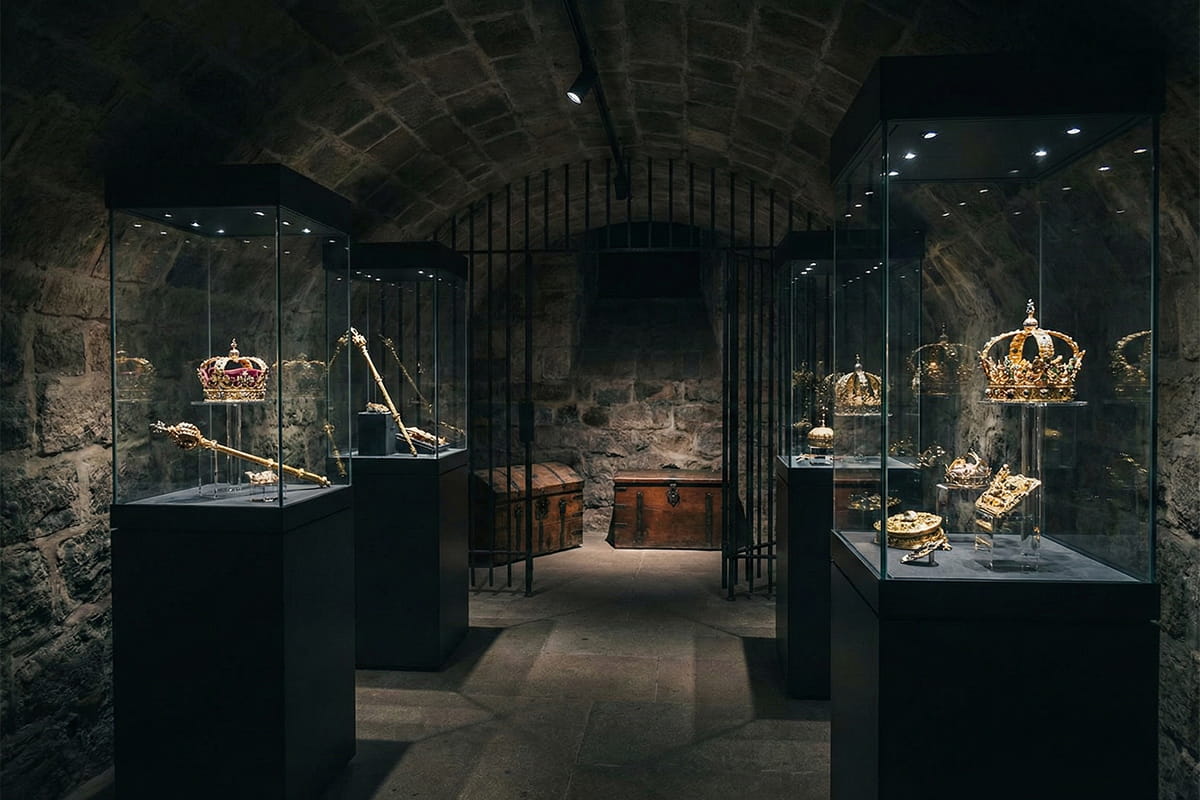
When you stand in the vibrant King's Garden, looking up at the Dutch Renaissance towers of Rosenborg, it is easy to get lost in the fairy-tale aesthetic of the spires against the Copenhagen sky. However, the true heart of the monarchy’s power does not lie in the airy upper chambers, but deep underground. Stepping away from the daylight and descending the winding stone stairs into the castle’s basement is a transition from a royal residence to a fortress of wealth. The air grows cooler, the walls thicker, and the atmosphere shifts from domestic luxury to solemn security. This is the Treasury, a subterranean vault designed not just to store wealth, but to survive the very collapse of the world above it.
The Architecture of Security: Built to Survive
The basement of Rosenborg Castle was constructed with a singular purpose: durability. While the upper floors were designed for balls, receptions, and the daily life of Christian IV, the lower levels were engineered to withstand fire, bombardment, and theft. The distinct barrel-vaulted ceilings you see today are not merely decorative; they are structural marvels capable of bearing immense weight. In an era when Copenhagen was frequently ravaged by fires—most notably the devastating blazes of the 18th century—these stone cellars offered a sanctuary where the kingdom's history could remain untouched by the flames. Consider, for instance, the Great Fire of Copenhagen in 1728, which destroyed a significant portion of the city, yet the Treasury remained unscathed, a testament to its robust design.
As you explore the history of the castle, you will discover that these thick masonry walls have done their job remarkably well. During the wars with Sweden and the later British bombardments, when other palaces crumbled or burned, the contents of the Rosenborg Treasury remained secure. The physical sensation of being down here is distinct; the acoustics are dampened, and the lighting is deliberately low to protect light-sensitive artifacts, creating an intimate environment where the gold and diamonds seem to glow with an inner fire. It is a testament to 17th-century engineering that this space remains as impenetrable and secure today as it was four hundred years ago.
Guardians of the Gold: Historical Measures
Security in the 1600s did not rely on lasers or motion sensors, but on physical barriers and human loyalty. The doors leading into the Treasury are masterpieces of ironwork, heavy and reinforced with complex locking mechanisms that required multiple keys held by different high-ranking officials. This ensured that no single person, not even the King at times, could access the entirety of the state's wealth on a whim. The layout of the basement itself served as a deterrent, with narrow passages that would make it impossible for a large group of looters to move quickly or unnoticed. Imagine the scene: guards patrolling the dimly lit corridors, their footsteps echoing off the stone walls, each responsible for a piece of the puzzle that protected Denmark's treasures.
The Crown Jewels: The Heart of the Vault
The undeniable highlight of your descent is the collection of the Danish Crown Jewels and Regalia. Unlike many other European monarchies where the jewels are kept in museums far removed from their original context, here they sit in the very castle where kings lived. The collection is divided into several key categories, each representing a different era of Danish power. To fully understand what you are looking at, it helps to know that these are not just accessories; they are legal symbols of the monarchy's authority.
You can read more specific details on our dedicated Crown Jewels & Regalia page, but standing before the glass cases, you will be struck by the craftsmanship. The absolute masterpiece is the Crown of Christian IV, a Renaissance wonder loaded with symbolic figures and allegories, contrasting sharply with the later, closed crowns of the absolute monarchs. These items are still in use today; the Queen’s Crown Jewels are the only ones in the world that are both displayed to the public and worn by the Queen for major state occasions within Denmark.
| Artifact Category | Key Highlights | Historical Era |
| The Old Regalia | Christian IV's open crown, the Sword of State | Renaissance (Pre-1660) |
| The Absolute Regalia | Crown of Christian V, The Orb, The Scepter | Absolute Monarchy (1660-1849) |
| The Crown Jewels | Emerald Parure, Pearl-Poire Set, Brilliant Set | Current Monarchy usage |
A Walk Through Wines and Weapons
The Treasury is not solely about gold and diamonds; it also houses curiosities that paint a vivid picture of royal life. As you navigate the vaulted corridors, you will encounter the Wine Cellar. Here, barrels of Rhine wine dating back centuries are stored. It is a fascinating tradition that this wine is still served on very rare, specific state occasions, connecting the modern royalty directly to the tastes of their ancestors. The scent of old oak and damp stone in this section adds a sensory layer to the visit that photographs simply cannot capture.
Furthermore, the basement houses an impressive collection of weapons. These are not the ceremonial swords found upstairs in the Rooms & Highlights section, but often personal weapons of the Kings, ornate saddles, and ivory carvings. It reflects a time when a King was expected to be a warrior as well as a ruler. The juxtaposition of lethal weaponry sitting just meters away from delicate pearl necklaces encapsulates the dual nature of power: force and beauty combined.
Planning Your Descent: Practical Information
Because the Treasury is located in the basement of a historic castle, there are some logistical factors to consider before you book your tickets. The environment is naturally darker and cooler than the rest of the museum, so bringing a light layer is advisable even in summer. The profound silence and narrow walkways require a respectful pace, allowing you to absorb the details without rushing. We recommend allocating at least 30 to 45 minutes specifically for the basement level to truly appreciate the depth of the collection.
- Timing: The Treasury can get crowded during peak hours. Try to visit early in the morning or late in the afternoon for a more solitary experience.
- Photography: Non-flash photography is permitted, but the low lighting requires a steady hand for clear shots of the sparkling gems.
- Bags: Large bags are not allowed in the narrow vault corridors; please use the lockers provided at the entrance.
Accessibility Considerations
It is important to note that Rosenborg is a preserved historic building, and the Treasury is located underground. This presents certain challenges regarding mobility. While we strive to make the castle as open as possible, the descent involves stairs and uneven stone floors that have been trodden on for centuries. For detailed information regarding elevator access limits and assistance, please consult our Accessibility page prior to your arrival to ensure a smooth experience.
Emerging from the Depths
Leaving the Treasury feels like traveling through time. You ascend from the dim, fortified silence of the 17th century back into the light of the present day. After seeing the heavy crowns and the cold steel of the swords, a walk in the fresh air is the perfect antidote. We highly recommend concluding your visit with a stroll through The King's Garden just outside. Seeing the castle from the outside after having been in its deepest foundations gives you a complete perspective of this magnificent structure—from the soaring towers to the secrets buried beneath.
Whether you are a history buff, a lover of jewelry, or simply a traveler looking for a unique atmospheric experience, the Treasury offers a glimpse into the soul of the Danish monarchy. Don't forget to check our Plan Your Visit section for opening hours and directions, and prepare to be dazzled by what lies beneath.