
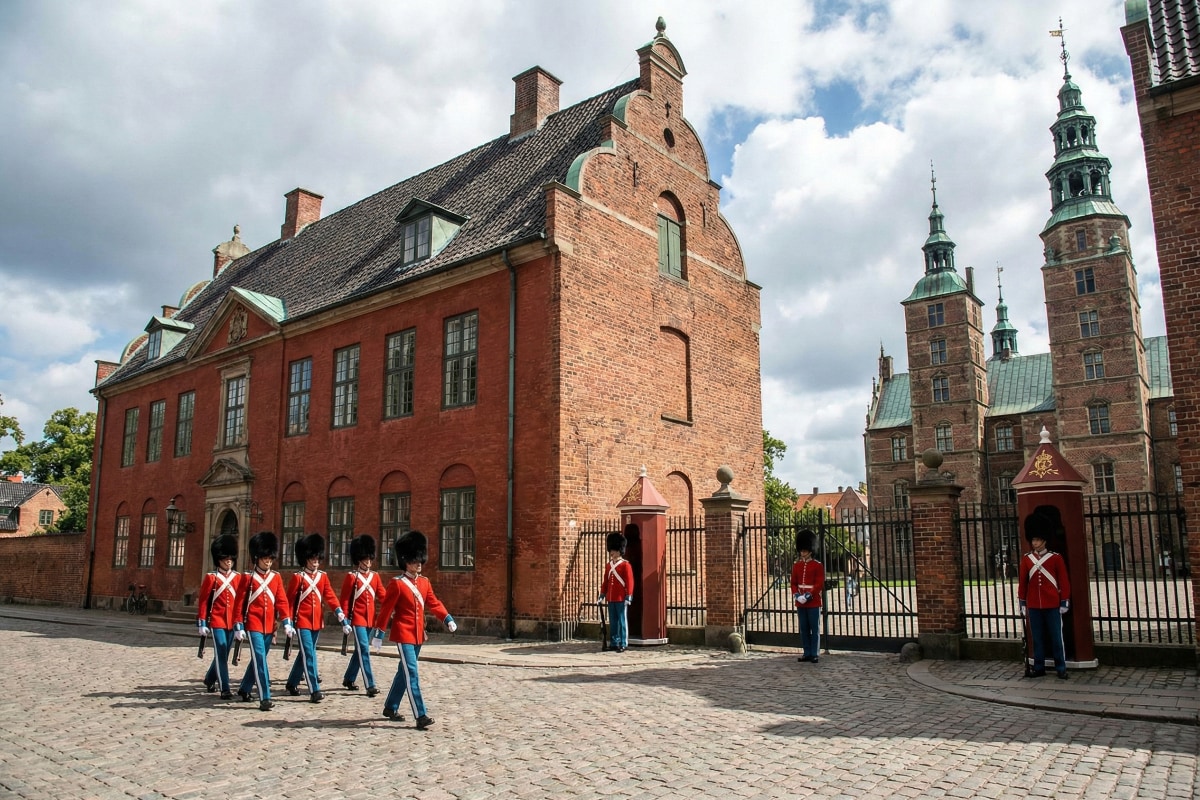
When you step through the wrought-iron gates into the heart of Copenhagen, the immediate draw is often the spires of the Renaissance castle rising above the trees. However, if you look just beyond the manicured lawns and the leisurely atmosphere of the park, you will encounter a living piece of Danish history that is as active today as it was centuries ago. The rhythmic sound of boots on pavement often cuts through the laughter of picnickers, signaling the presence of the Royal Life Guards at Livgardens Kaserne. This juxtaposition of a relaxed public space and a rigid military institution creates a unique atmosphere that defines the area surrounding Rosenborg.
For many visitors, the castle is a museum of treasures, but for the soldiers stationed next door, this ground is a place of duty. The barracks, located along Gothersgade and bordering the castle grounds, serve as the starting point for one of Copenhagen’s most famous daily rituals. Understanding the connection between the guards, their historic home, and the surrounding greenery adds a profound layer of depth to your visit. It is not just about seeing a castle; it is about witnessing the continuity of a monarchy and the traditions that protect it.
The Historic Livgardens Kaserne
The long, distinct building that houses the Royal Life Guards has a history as colorful as the uniforms worn by its inhabitants. Originally built in the 18th century, the structure was not initially intended for soldiers but has evolved over time to become the nerve center of the Royal Guard. Known locally as Livgardens Kaserne, these barracks are situated right on the edge of The King's Garden. Unlike many historical military sites across Europe that have been converted into museums or luxury apartments, these barracks remain fully operational.
The architecture itself tells a story of adaptation. While the castle represents the pomp and grandeur of Christian IV's era, the barracks represent the practical side of royal life. The proximity to Rosenborg is no accident; historically, the King’s Garden was a private pleasure garden for the monarch, and having the royal protection force immediately adjacent was a matter of security and logistics. Today, looking at the barracks from the garden side offers a visual anchor, reminding visitors that while the park is now public property, its roots are deeply royal and military.
If you are interested in how the castle grounds evolved from a private sanctuary to a public space alongside these military installations, you can dive deeper into the site's History. The transition of the barracks from an Orangery complex to military quarters is a testament to the changing needs of the Danish capital over the centuries.
A Living Tradition: The Royal Life Guards
The Royal Life Guards (Den Kongelige Livgarde) are perhaps the most photographed soldiers in Denmark, instantly recognizable by their bearskin caps and blue (or occasionally red) ceremonial uniforms. Founded in 1658 by King Frederik III, this regiment has a dual role: they are a front-line combat unit of the Danish Army, and they serve as the personal guard to the Monarch. When you see them marching near Rosenborg, you are seeing highly trained soldiers, not just ceremonial actors.
The daily life of a guard at Livgardens Kaserne is a blend of intense discipline and public visibility. Their presence adds a sense of solemnity to the otherwise cheerful ambiance of the gardens. It is a fascinating experience to stand near the Rosenborg drill grounds and watch the preparation for the Changing of the Guard. Before they march through the city streets toward Amalienborg Palace, the initial inspections and formations often take place here, offering a behind-the-scenes glimpse to lucky bystanders.
Identifying the Uniforms
Visitors often wonder why the uniforms change color. It is not a seasonal fashion choice but a matter of occasion. Understanding what you are looking at can enhance your appreciation of the tradition:
- Blue Uniforms: These are the standard daily service uniforms worn for guard duty when there are no special royal events.
- Red Gala Uniforms: These are reserved for special occasions, such as the Monarch's birthday or major state visits.
- Bearskin Caps: Worn by all guards on watch, these iconic hats weigh several kilograms and are a symbol of the regiment's history.
The Symbiosis of Park and Barracks
What makes a visit to this area truly special is the seamless integration of two very different worlds. On one side of the path, you might see families enjoying a picnic, students reading on blankets, or couples strolling under the ancient lime trees. On the other side, just meters away, young conscripts might be practicing their drills or maintaining their equipment. This is the essence of Copenhagen—a city where history is accessible and integrated into modern life.
The King's Garden acts as a green buffer zone. It softens the stark reality of the military installation, while the barracks provide a historic backdrop that frames the garden. This relationship is mutually beneficial; the presence of the guards provides a sense of security and tradition that elevates the park above a standard city green space. It reminds us that we are walking on royal grounds. To fully explore the layout of the area and find the best vantage points to see the barracks, you should Plan Your Visit in advance.
| Feature | The King's Garden Atmosphere | Livgardens Kaserne Atmosphere |
| Primary Sound | Birdsong, laughter, rustling leaves | Marching boots, shouted commands, drums |
| Visual Style | Organic, green, flowery borders | Structured, red brick, uniform symmetry |
| Accessibility | Open to the public daily | Restricted military zone (view from outside) |
| Best Time to View | Mid-day for picnics and sun | Late morning before the guard march |
From the Barracks to the Treasury
The guards stationed at the barracks are there for a reason: the protection of the monarchy and its treasures. While the Royal Family no longer resides at Rosenborg, the castle houses something of immense value—the Danish Crown Jewels. The symbolic link between the soldiers outside and the treasures in the basement is powerful. The guards are the living shield; the jewels are the historic heart.
After observing the barracks and the exterior drills, moving inside the castle completes the narrative. You transition from the protectors to the protected. The basement treasury is a highlight, featuring crowns, scepters, and orb that are still used by the Royal Family today. To ensure you can enter the castle and see these items, it is highly recommended to check availability online. Since the castle has limited capacity, you should secure your spot early.
Practical Tips for the Observer
If you want to focus your visit on the military history aspect, timing is everything. The Royal Life Guards depart from the barracks on Gothersgade around 11:30 AM to march towards Amalienborg Palace for the changing of the guard at noon. Catching them as they form up near the barracks offers a closer, less crowded view than at the palace square.
Beyond the daily Changing of the Guard, the Royal Life Guards occasionally participate in public events and ceremonies. Check local listings or the official website of the Danish Monarchy for announcements of special parades, concerts, or historical reenactments that might coincide with your visit. These events offer a unique opportunity to witness the guards in their full regalia and experience Danish military tradition firsthand.
Accessibility around the barracks' exterior and the main paths of the King's Garden is generally good. The paths are wide and paved, suitable for wheelchairs and strollers. However, be aware that the interior of the castle has many stairs. For specific details on navigating the grounds with mobility aids, please review our Accessibility page.
Connecting the Dots
A trip to Rosenborg is incomplete without acknowledging the men and women in uniform who share the postcode. The barracks are not just a backdrop; they are a pulse. As you wander through the Rooms & Highlights of the castle, imagine the centuries of soldiers who have kept watch outside those very windows. It grounds the fairytale appearance of the castle in a very real, human reality.
Whether you are a military history buff or simply a traveler soaking in the atmosphere of Copenhagen, taking a moment to look "beyond the walls" of the garden and into the life of the barracks enriches your understanding of Danish culture. It is a dance between the past and present, the relaxed and the rigid, all playing out under the green canopy of the King's Garden.