When you step into the darkened, secure vaults of the Treasury at Rosenborg Castle, the air seems to vibrate with centuries of history. Among the glittering array of scepters, orbs, and diamonds, one object commands immediate and total reverence: the Crown of Christian V. It is not merely a piece of jewelry or a display of wealth; it is a meticulously crafted political manifesto forged in gold, enamel, and precious stones. For visitors and history enthusiasts alike, standing before this masterpiece is the highlight of exploring the Crown Jewels & Regalia. To truly appreciate what you are seeing, however, one must look beyond the sparkle and decode the profound symbolism of absolute power that defines its structure.
The era of absolute monarchy in Denmark, ushered in by Frederick III and solidified by Christian V, required a new visual language. The previous open crowns, used by elected kings, were no longer sufficient to convey the new reality: that the King was answerable to no one but God. Crafted by the royal goldsmith Paul Kurtz between 1670 and 1671, this crown was designed to replace the open crown of Christian IV, signaling a complete paradigm shift in Danish governance. This shift occurred amidst a broader European context, where absolute monarchies were consolidating power, often drawing inspiration from the Roman Empire's symbols of authority. As we explore the details of this regalia, we uncover a story of divine right, artistic mastery, and a king's unyielding assertion of authority.
The Symbolism of the Closed Arches
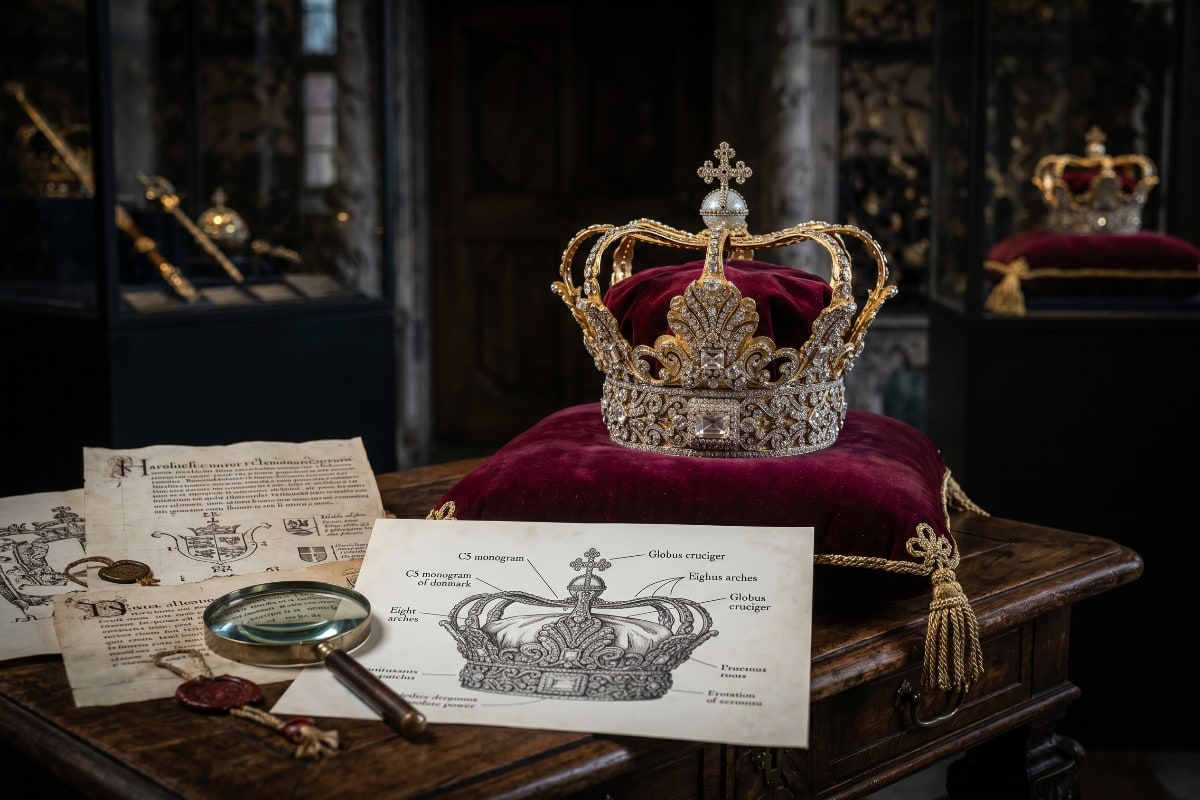
The most distinct feature of Christian V's crown, and the one that carries the heaviest political weight, is its shape. Unlike the open, diadem-style crowns of his predecessors, this crown features two large arches that cross over the top, effectively "closing" the crown. In the language of 17th-century European politics, this was not an aesthetic choice but a declaration of independence. An open crown suggested a king who might be subject to an emperor or a council of nobles. A closed crown, conversely, symbolized imperial power and total sovereignty.
By closing the arches, Christian V was visually stating that his power was absolute and complete within his realm. The arches meet at the top to support a globe and a cross, further emphasizing that the monarch's authority came directly from the Divine, bypassing any earthly institutions. If you are eager to learn more about the political landscape of this era before your visit, our History page offers a deep dive into the transition to absolutism.
- Total Weight: Approximately 2080 grams of gold and gems.
- The Arches: Symbolize independent, imperial power.
- The Cross: Represents the King's direct connection to God.
- The Maker: Paul Kurtz, the renowned royal goldsmith.
The Great Sapphire and Divine Authority
While the gold and diamonds are breathtaking, the true spiritual anchor of the crown is the massive sapphire located on the front of the circlet. This is not just a gemstone; it is a legendary artifact. Tradition holds that this sapphire was a gift from the Duke of Milan, and its placement is strategic. In the iconography of the time, blue sapphires were often associated with chastity, heavenly favor, and deep spiritual connection. Beyond this, sapphires were believed to possess protective qualities, shielding the wearer from harm and negative energies, further reinforcing the King's divinely ordained role. By placing such a dominant blue stone at the forefront, the crown serves as a testament to the King's divine authority.
The sapphire acts as a grounding element amidst the intricate gold acanthus leaves and diamond-studded ribs. It reminds the viewer that while the King possesses absolute power on earth, he is serving a higher, celestial purpose. The interplay of light on this specific gem is mesmerizing, and seeing it in person is a reminder of the immense resources the monarchy commanded. For those planning to witness this spectacle, we recommend checking our Plan Your Visit page to ensure you have ample time to admire the details.
The Craftsmanship of Paul Kurtz
The execution of this design fell to Paul Kurtz, a master whose work defined the aesthetic of the Danish absolute monarchy. The crown is not just a rigid symbol; it is a work of art. The gold ring is adorned with large table-cut stones and four large sapphires, interspersed with diamond-encrusted palmettes. The craftsmanship involved in setting these stones—ensuring they caught the candlelight of the 17th century while remaining secure for centuries—is nothing short of miraculous.
| Component | Material & Detail | Symbolic Meaning |
| The Circlet | Gold with table-cut stones and sapphires | The earthly foundation of royal power. |
| The Arches | Gold encrusted with diamonds | Sovereignty and the closing of the realm against external interference. |
| The Globe & Cross | Blue enamel and diamonds | The triumph of Christianity and the King as God's representative. |
| Lining | Red velvet cap (originally embroidered) | Royal dignity and the blood of the monarchy. |
From Coronation to Anointing
An interesting historical nuance is that Christian V was never "crowned" in the traditional sense with this object. Because he was an absolute monarch by hereditary right, the act of a human placing a crown on his head would have implied that a human gave him power. Instead, the ceremony was changed to an "anointing." During the ceremony, the King would enter the church already wearing the crown, signifying that his power existed before the ceremony began. He would then be anointed with holy oil, sanctifying a power he already possessed.
The Crown of Christian V is a masterpiece you must see with your own eyes. Don't miss the chance to walk through the Treasury.
Planning Your Encounter with the Crown
Today, the crown rests in the secured vaults of Rosenborg Castle, accessible to the public but heavily guarded. As of December 2025, the display continues to draw thousands of visitors who are captivated by the sheer aura of the object. The lighting in the treasury is deliberately kept low to accentuate the sparkle of the diamonds and the deep glow of the gold and sapphire.
When you visit, take note of the other regalia nearby, including the scepter and orb, which complete the trinity of royal symbols. However, the Crown of Christian V remains the undisputed centerpiece. For visitors with mobility concerns, please review our Accessibility guide, as the Treasury is located in the basement levels of the castle. After soaking in the intensity of the treasury, many visitors find it refreshing to take a stroll in The King's Garden, reflecting on the immense history they have just witnessed.
Whether you are a student of political history or simply a lover of exquisite jewelry, the Crown of Christian V offers a tangible connection to a time when kings were seen as divine rulers of the earth. It is a symbol of absolute power that has survived the test of time, waiting for you to decode its secrets.