
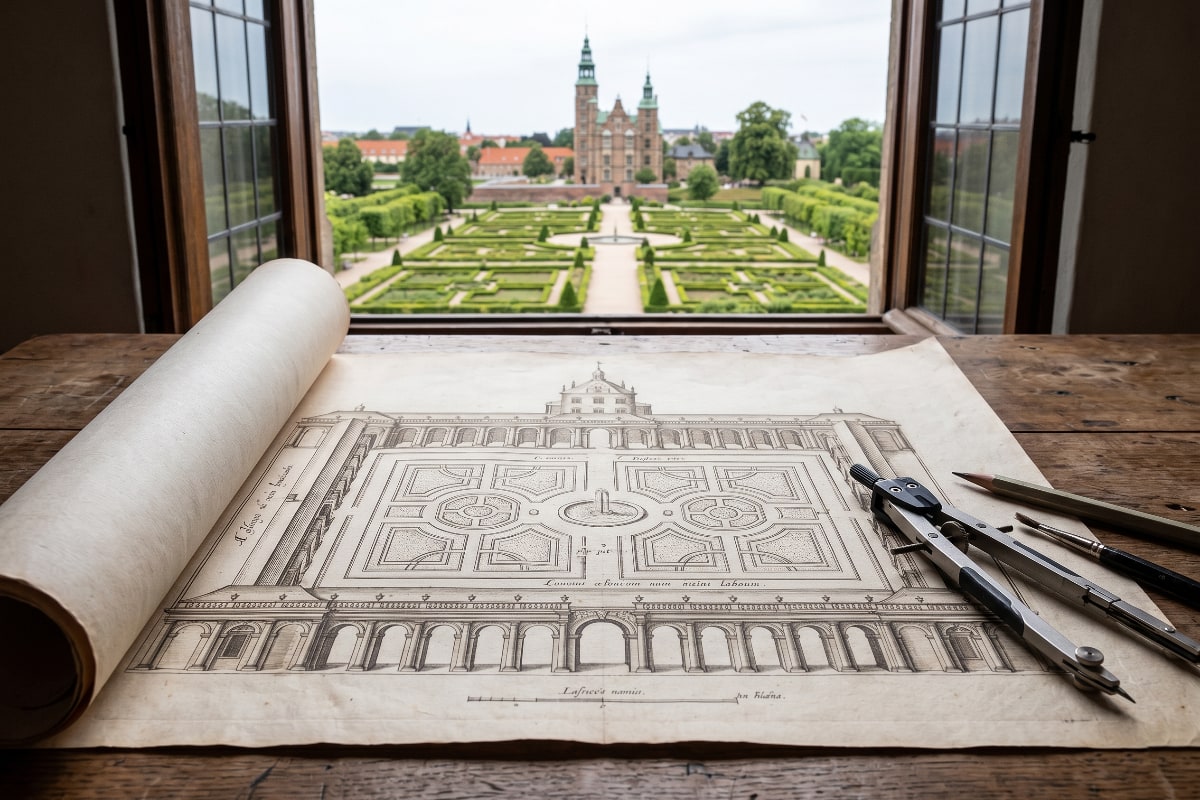
When you step through the wrought-iron gates into the heart of Copenhagen, the city’s modern hum seems to fade, replaced by the rhythmic crunch of gravel underfoot and the whisper of wind through ancient branches. You are not just entering a park; you are stepping onto a blueprint drawn up over four centuries ago. While many visitors flock here for a casual picnic or a glimpse of the castle, the true magic lies in the ground beneath their feet. This is a living testament to King Christian IV’s obsession with order, geometry, and the distinct style of the Renaissance.
Unlike the wild, organic curves of later Romantic gardens, The King's Garden (Kongens Have) was born from a desire to tame nature. Established in the early 17th century, it was designed to reflect the power of the monarch and the clarity of the human mind. Even today, as we walk these paths in December 2025, the skeleton of that original vision remains remarkably intact. It is a place where every line, every angle, and every tree was placed with specific intent, creating a green stage for royal pageantry that has miraculously survived the passage of time.
The Architect King’s Vision of Order
Christian IV was not a king content to sit idly on his throne; he was a builder, a dreamer, and arguably Denmark’s most ambitious city planner. His reign transformed the skyline of Copenhagen, but his personal sanctuary was here, just outside the city ramparts of the time. To understand the garden, one must understand the man. He sought to impose structure upon chaos, a hallmark of Renaissance thinking. The garden was an extension of the castle itself—an outdoor room where the walls were made of linden trees and the ceiling was the open sky.
The layout was never accidental. It was a rigorous exercise in geometry. The King employed a grid system, a checkerboard of parterres and paths that allowed for long, uninterrupted lines of sight. This wasn’t just for aesthetic pleasure; it was a display of control. By forcing nature into straight lines and perfect right angles, the King demonstrated his dominion over the earth. If you are interested in the man behind this grand design, a dive into the site’s History section reveals how his architectural legacy defined an era.
Uncovering the Geometric Secrets
To the untrained eye, the park might just seem like a lovely place for a stroll. However, if you look at an aerial map or simply stand at the intersection of the main avenues, the Renaissance grid reveals itself. The park is bisected by two principal avenues: The Knight’s Path (Kavalergangen) and The Dame’s Walk (Damegangen). These are not merely walkways; they are the spine and ribs of the garden’s anatomy.
The geometric secrets of the layout serve a dual purpose:
- Perspective and Infinity: The long, straight avenues were designed to draw the eye toward the horizon or a focal point, creating an illusion of infinite space within a confined city area.
- Social Hierarchy: The width and placement of paths dictated who walked where. The broad avenues were for the court to see and be seen, while narrower paths offered seclusion.
This strict adherence to geometry creates a sense of calm that is palpable even 400 years later. It is a stark contrast to the winding, unpredictable streets of medieval Copenhagen. Here, everything makes sense. Everything is balanced.
The Lime Tree Avenues: A 400-Year-Old Legacy
Perhaps the most iconic features of Christian IV’s original design are the lime tree avenues. These trees are the soldiers of the garden, standing in formation to guard the geometry of the King’s vision. While the individual trees have been replanted over the centuries to maintain the health of the park, the lines they occupy have not moved.
Walking down the Knight’s Path, you are tracing the exact footsteps of Danish nobility from the 1600s. The trees are pruned to form high green walls, creating what is essentially an architectural corridor. In the summer, they provide a cool, emerald tunnel; in the winter, their bare branches reveal the stark, beautiful precision of the planting grid. It is a masterful integration of horticulture and architecture.
Maintaining these avenues requires immense dedication. It is not simply gardening; it is curation. The gardeners must balance the health of living organisms with the strict requirements of historical preservation. This dedication ensures that the "walls" of Christian IV's outdoor rooms remain standing.
The Krumspringet: Symmetry Restored
One of the most fascinating elements to explore is the area known as the Krumspringet. For years, this section had lost some of its original definition, but recent restoration efforts have brought back the sharp symmetry that Christian IV prized. The Krumspringet is a testament to the Renaissance love for intricate patterns.
It features a meticulously maintained rose garden and boxwood hedges arranged in complex geometric shapes. It reflects a vision of beauty that is mathematical in nature. The restoration of the Krumspringet allows us to see the garden not as it evolved, but as it was intended: a place where nature is perfected through human ingenuity. It is a highlight for anyone who appreciates the intersection of art and nature.
Renaissance vs. Romantic: A Garden of Two Eras
While the blueprint is Renaissance, the garden has seen changes. It is helpful to understand what belongs to Christian IV’s original grid and what was added later during the Romantic period, which favored wilder, more "natural" landscapes.
| Feature | Renaissance (Christian IV) | Romantic / Later Additions |
| Layout Philosophy | Strict geometry, straight lines, symmetry. | Curved paths, organic shapes, surprise views. |
| Vegetation | Clipped hedges, lime avenues, fruit trees. | Free-growing large trees, English landscape style. |
| Water Features | Moats and geometric basins. | Naturalistic ponds. |
| Purpose | Production (fruit/herbs) and Royal Promenade. | Public leisure and scenic beauty. |
Despite later influences, the dominance of the Renaissance grid is what gives Rosenborg Castle Gardens its unique character. It anchors the site in history, refusing to be entirely swept away by changing fashions.
Experiencing the Garden Today
Today, the garden serves as a bridge between the past and the present. It is accessible to everyone, a democratic evolution of a once-exclusive royal retreat. If you are preparing for a trip, checking the Accessibility page is recommended, as the historic gravel paths can vary in texture, though the main avenues remain wide and navigable.
To truly appreciate the design, try to visit during the "golden hours" of early morning or late afternoon. The low light accentuates the long shadows of the lime trees and highlights the precision of the grid. Before you go, be sure to Plan Your Visit to check for any seasonal events or maintenance work that might affect access to certain paths.
After exploring the grounds, the natural next step is to enter the castle itself. Here, you can see the Crown Jewels & Regalia and look out from the upper Rooms & Highlights. The view from above offers the ultimate perspective on the garden's geometry, revealing the checkerboard patterns that are harder to perceive from the ground.
Christian IV’s garden is more than just a park; it is a document of history written in soil and bark. It tells the story of a King who wanted to bring order to his world, a vision of beauty that has miraculously survived for over 400 years. As you walk the Kavalergangen, remember: you are walking a line drawn by a King, kept alive by centuries of care.
Ready to experience this historical masterpiece firsthand? Plan your visit to Rosenborg Castle Gardens today and step back in time!